RISK MANAGEMENT
With the objective to gain a holistic view of associated risks across diverse businesses and effectively monitor and manage them, CAMS has in place a comprehensive ERM framework, reviewed annually by the Board. The framework has been structured in harmony with the business environment and ensures the highest standard.
Reflecting our dedication to minimise uncertainty and strengthen our risk controls, our framework was reviewed by KPMG. Following their recommendations, we introduced risk champions to embed risk awareness and accountability in our day-to-day operations along with making structural improvements and enhancing record-keeping in our framework, risk appetite and KRI. By integrating risk management more deeply within our first line of defence, we also reinforced the foundation of three lines of defence.

For a detailed overview, of the MDA, click here
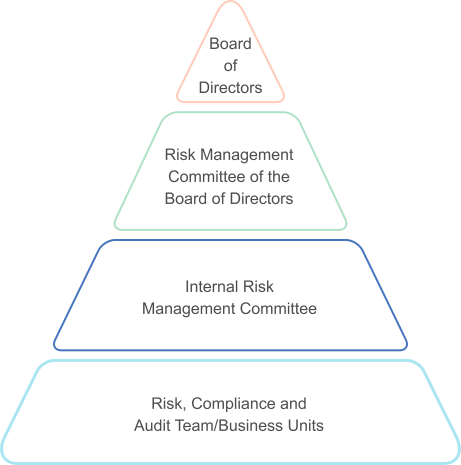
A robust Enterprise Risk Management Framework underlines our success in building an organisation well-equipped to handle and respond to potential risks while capitalising on business opportunities, helping us maintain credibility and maximise performance. The framework is annually reviewed by the Board and the responsibility to implement and track the ERM projects until completion lies on the Board Committee and Internal Committee(s).
Strategically aligned with our risk appetite and business goals, the framework helps us to effectively identify, and address risks related to shifts in market trends, credit and liquidity risks, risks arising from supply chain disruptions and system failures, technical and cybersecurity risks, and regulatory and compliance breaches, among many other.

Our operations are highly data-intensive, digitally-driven, and involves significant volumes of client data. Inability to safeguard the privacy of this data and protect it from cybersecurity breaches can adversely impact our reputation and lead to substantial financial losses.
Implementation of a strong cybersecurity policy helps us manage cybersecurity risks. The policy is governed by technology committee and regularly audited by internal and external teams, including external specialist firms.
Potential cybersecurity risks are further mitigated through deployment of best-in-class solutions such as:

CAMS is in top one percentile of the industry with Overall Security Posture, currently at 800


Our operations is susceptible to the risk of errors or omissions which may lead to significant financial or reputational loss.
A series of measures are taken to monitor and minimise operational risks:

Critical Incident Reporting tracker, proactive monitoring of potential risks


Our businesses are required to undergo periodic audits and comply with a host of guidelines set by various regulators. Non-compliance to such regulations could result in observations from authorities like SEBI, IRDAI, RBI, and MCA, that may lead to warnings, penalties, and even cancellation of licenses.
A robust compliance mechanism ensures that we abide by the required regulatory requirements. This includes:

Internal compliance monitoring tools including Legatrix – an external third-party tool for identifying any potential violations or defaults


We are subject to multiple regulatory requirements and our inability in doing so may lead to fines and penalties. The requirements include timely reporting to government agencies and regulators and errorfree fulfilment of regulatory requirements.
Highly-experienced employees with profound understanding of the system and compliance requirements ensure extensive interpretation and implementation of systemic solutions and exploring automation opportunities.
To foster an error-free environment, we constantly test and monitor the effectiveness of our controls.
Conduct of extensive audits, either internally or by clients or regulators, serve as third line of defence, safeguarding us from potential compliance threats.

Legatrix, Dashboard-based monitoring, specific set of individuals tracking compliance


Given the limited consumer base and increasing demand for superior and differentiated services, the Company is required to enhance customer satisfaction to drive loyalty and retain its existing clients. Our failure to do so may pose concentration risk and directly impact our revenues.
Our focus on exploring new areas and diversifying our businesses over the last few years has led to an increased contribution of the non-mutual fund revenue to the overall revenue.
A higher customer satisfaction score, backed by client satisfaction survey results, product innovation, technology and our ability to attract new MF clients, highlights our strength in effectively managing concentration risk.

Customer satisfaction surveys